
This is the “Black Belt” of drywall repairs. The California patch—or the “Butterfly Patch”—is how you fix a hole when there’s absolutely nothing behind it to screw into. No studs, no blocking, just a gaping void and a homeowner who wants it gone yesterday.
I’ve seen too many people fall for the “Home Center Trap”—those sticky metal mesh kits. Personally? Those mesh kits are garbage. I’ve tried teaching apprentices to use them, and I always end up coming back to a disaster that I have to spend two hours feathering out. A California patch is a cleaner, stronger, and more “Journeyman” way to handle the job.
But before you start swinging your saw, you need to know how to not hit a wire and why your choice of mud is the difference between a clean finish and a dusty nightmare.
Direct Answer: How to Back-Patch Drywall Without a Stud
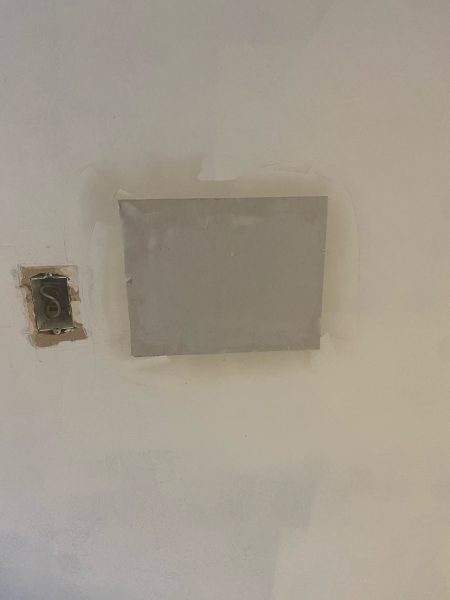
The best way to patch drywall without a stud is using the “California Patch” method, where you cut a new piece of drywall larger than the hole and peel away the gypsum to leave a 2-inch “paper flange” on all sides. This flange acts as the tape, allowing the patch to be mudded directly into the wall without the need for internal wood backing or mesh kits. For the flattest finish, use a stiff-edged cement trowel to feather the edges into the existing wall.
The Journeyman Toolkit: The Essentials
You don’t need a truckload of tools for this, but the ones you choose matter. Don’t go cheap on the mud box.
🛠️ The Cutting Edge
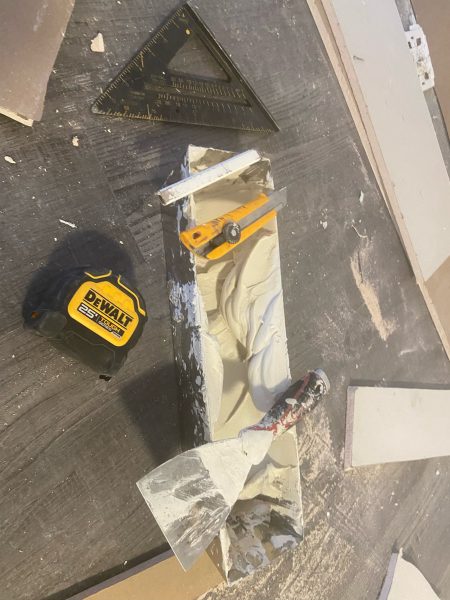
- Oscillating Multi-Tool (The only way to square a hole without a workout).
- Retractable Utility Knife (Get the one with the screw-lock for safety).
- 25ft Tape Measure.
🛠️ The Mud & Smooth
- Dust Control All-Purpose Drywall Compound (Your lungs and your vacuum will thank you).
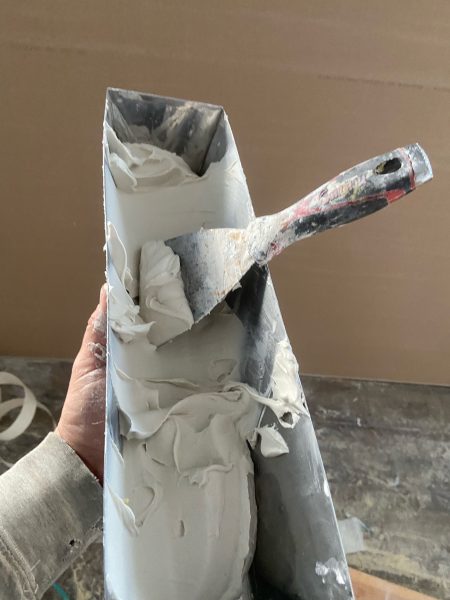
- Stainless Steel Mud Box.
- 12-inch Cement Trowel (The secret weapon for beginner feathering).
Step 1: The “Educated Guess” Square-Up
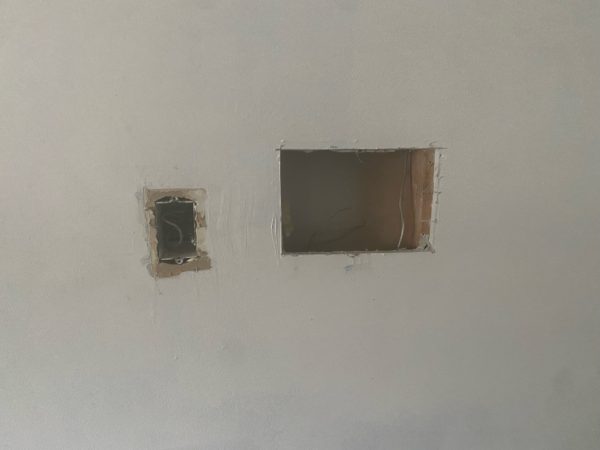
Before you fix the hole, you have to make it bigger. I know that sounds backward, but a jagged, round hole is impossible to patch cleanly.
Take your pencil and square up the hole. Now, here is my “Journeyman Rule” for the oscillating saw: Never plunge it in as far as it can go. You can never be 100% sure what’s behind that wall. I’ve seen guys plunge full-depth and zip right through a Romex wire or a PEX line. If your scared theres a lot of pipes or electrical behind the wall use a drywall hand saw it slower but harder to cut through pipe and electrical with a hand tool.
The Trick: I set my depth by sight. I only plunge the saw the exact thickness of the drywall (usually 1/2″ or 5/8″). You want to “kiss” the space behind the wall, not dive into it. Once you’ve squared it up, you have a clean void ready for the butterfly.
Step 2: Building the “Butterfly” Patch
This is where the magic happens. You’re going to create a piece of drywall that carries its own tape.
- Measure the Hole: Let’s say your squared-up hole is 4×4 inches.
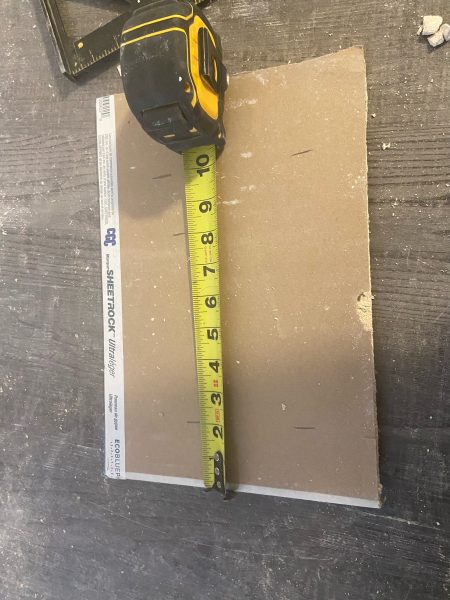
- Cut the Patch: Cut a piece of scrap drywall that is 3 inches larger on every side. So, for a 4-inch hole, you want a 10×10 inch square.
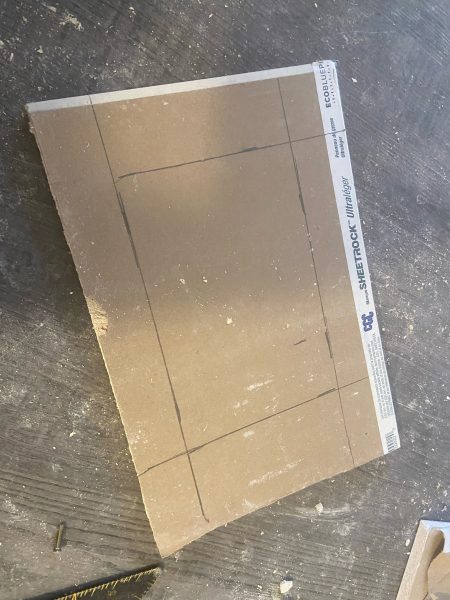
- The Back-Score: Flip the patch over so you’re looking at the brown paper side. Measure in 3 inches from every edge and draw lines. This should leave a 4×4 square in the middle that matches your hole.
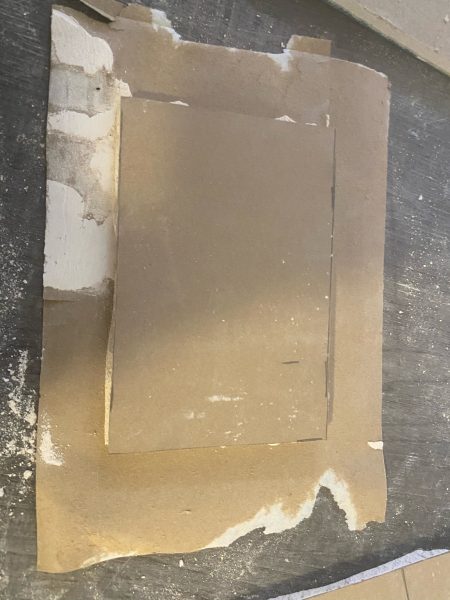
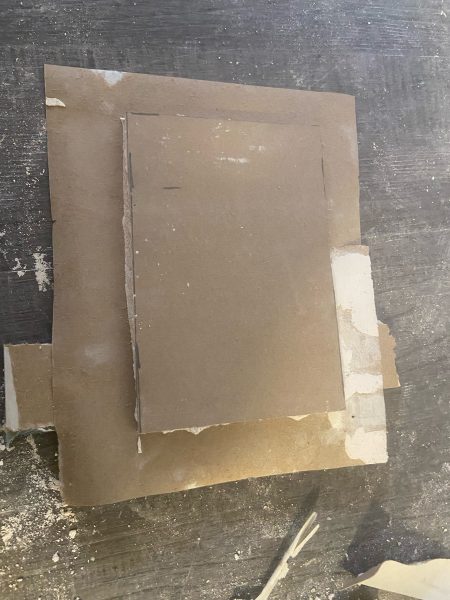
- The Snap and Peel: Score those lines with your knife. Snap the gypsum toward the white (front) side. Now, slowly and carefully, peel the gypsum away from the front paper.
- Journeyman Tip: If you go too fast, you’ll rip the front paper. You want that middle 4×4 “plug” to have a wide, clean paper “wing” or “flange” all the way around it.
Step 3: The “Dry Fit” (Do Not Skip This)
I’ve watched apprentices skip the dry fit, slap a “fat” bead of mud on the wall, and then realize the patch is 1/8th of an inch too big. Now they have a mud-covered piece of trash and a mess on the floor.
Always dry fit the patch first. It should slide into the hole easily. If it’s tight, trim the gypsum plug with your knife. You want it to sit flush with the wall without forcing it.
Step 4: The Mud Choice (Why I Hate Hot Mud)
A lot of guys will tell you to use “Hot Mud” (setting compound) for patches because it dries in 20 minutes. I’m not a fan. Hot mud is a nightmare for beginners. It’s less workable, it’s a beast to sand if you leave a hump, and if you’re working in a house that people actually live in, it’s just too much stress.
I prefer All-Purpose (Blue Lid) mud, specifically the Dust Control variety. When you’re patching a hole in a finished living room, drywall dust gets into every fiber of the carpet and furniture. Dust Control mud is heavier; it drops straight to the floor in clumps instead of floating into the HVAC system. It’s more workable, gives you time to feather, and is much more forgiving.
Step 5: Setting the Patch
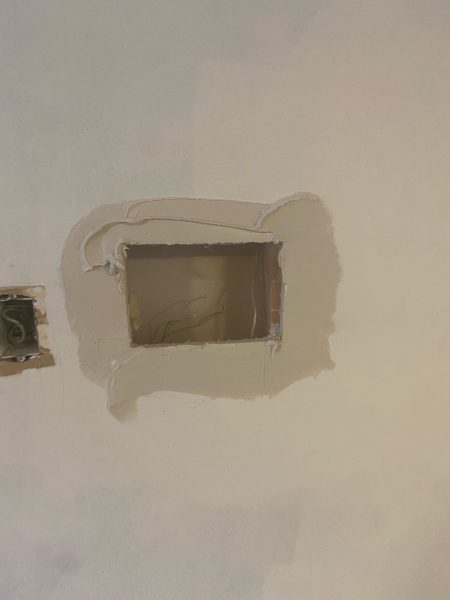
- The Mud Bed: Take your knife and apply a “fat” layer of mud around the edges of the hole on the wall.
- Embed the Butterfly: Push the patch into the hole.
- The Squeegee: Use your knife to lighty press the paper wings into the mud. You want to squeeze out the excess mud from under the paper, just like you would with regular tape.
- The “Cement Trowel” Hack: Most people use a 6-inch drywall knife to finish. For beginners, I recommend a stiff-edged cement trowel. Because it’s stiffer and wider, it spans the distance from the patch to the wall better, making it almost “dummy-proof” to get a flat finish without a hump.
Comparison: California Patch vs. Mesh Kits
| Feature | California (Butterfly) Patch | Store-Bought Mesh Kit |
| Cost | Almost Free (uses scraps) | $10 – $15 |
| Strength | High (Drywall-to-Drywall bond) | Low (Glue-based) |
| Finish Quality | Invisible if feathered right | Often leaves a “hump” |
| Beginner Friendly | Requires a bit of practice | Easy to start, hard to finish |
FAQ: 2026 Patching Standards
1. How big of a hole can I fix with this?
I’ve used California patches for holes up to 12×12 inches. I have even heard of guys doing 24×30 inch size holes obviously at that size they put in screws but still butterfly patch easier to mud cleaner seamless look.
2. Will it crack without a stud?
If you use enough mud under the paper flange and use All-Purpose compound, it won’t crack. The paper acts as a structural bridge. Just don’t go punching the wall in the same spot again.
3. Can I paint it immediately?
No. Even with the “Hot Mud” guys, you shouldn’t paint until the patch is fully dry and primed. If you don’t prime, the patch will “flash,” and you’ll see a dull square through your nice paint.
What’s Next?
Now that the wall is flat again, you might realize the rest of the room needs some love.
- Got a corner that looks rough? Check out my guide on Mudding Inside Corners on Drywall.
- Fixing up a bathroom? Don’t miss my breakdown on Which mud box is Best.
For more “No-Nonsense” Journeyman advice, head over to Journeymantips.com.