
Difficulty: Level 2 (Requires some muscle)
Time: 20–30 Minutes
You’ve got a bathtub that drains slower than a turtle, or maybe the chrome finish is chipping off and it looks terrible. You decide to swap it out. You look online, and everyone tells you to go buy a special Tub Drain Removal Tool (often called a Dumbbell Wrench).
That tool is great. It costs less than $15, and if you are doing this every day, you should buy one. But it’s Sunday night, the hardware store is closed, and you want this job done now.
Don’t worry. I’ve removed lots of drains, and while the tool is nice, you can get it done with the tools already in your bag. Here is the “Journeyman Way” to remove a stuck tub drain using just leverage and patience.
Stop! Do You Actually Need to Remove It?
Before you start wrenching, ask yourself: Am I removing this just to clean a clog?
If the drain is just slow, do not remove the drain body. You risk breaking the seal or shifting the gasket underneath (more on that later). Instead, try the “Shop-Vac Suck”:
- Prep the Vac: Take your Shop-Vac and switch it to “Wet Mode” (remove the paper filter and put on the foam sleeve).
- The Seal: Place the vacuum hose directly over the drain hole. Use your hand (or the rubber gasket from a new drain) to create an airtight seal around the hose.
- The Pull: Turn it on. You will be amazed at what comes out. (I usually use long Needle Nose Pliers to grab the initial hairball first).
- The Refill: Important: The vacuum is powerful enough to suck the water out of your P-trap (the pipe curve that blocks sewer gas). Once you are done, pour a cup of water down the drain immediately. If you don’t, your bathroom will smell like sewer gas within an hour.
The “Hack”: Removing the Drain Without a Tool
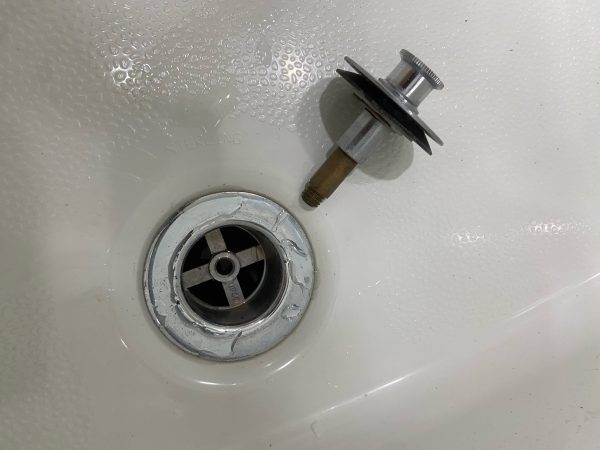
If you are replacing the drain, it has to come out. Tub drains are screwed into a “shoe” underneath the tub. Over years of use, the old putty hardens, and calcium builds up, locking it in place.
Here are two ways to break it loose without the specialty wrench.
Method 1: The “Double Wrench” Leverage (High Torque)
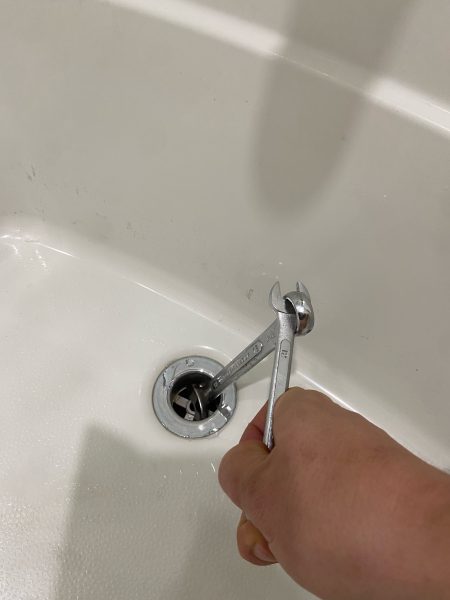
The hardest part is getting enough torque to break the initial seal.
- The Insert: Take a standard Crescent Wrench (Adjustable Wrench) and stick the handle end down into the drain, wedging it between the metal crossbars (the “X” inside the drain).
- The Lever: Take a second wrench (or a large screwdriver) and lock it onto the top of the first wrench to create a “T-handle” or an extension.
- The Turn: Use that extra length to crank it “Lefty-Loosey” (Counter-Clockwise). The extra leverage breaks the calcium seal that pure wrist strength can’t touch.
Method 2: The Pliers “Wedge”
If the crossbars are thin or broken, I like to use Locking Pliers / Vise-Grips.
- Don’t Lock Them: Open the jaws wide—wider than the drain opening.
- The Jam: Jam the nose of the pliers down into the drain. You aren’t trying to clamp onto the crossbars; you are trying to wedge the jaws against the inside walls of the drain or catch the base of the crossbars.
- The Twist: Because the pliers are wider, you get better rotation. Twist hard. Once it pops loose, it should spin out easily.
The Scary Part: The Rubber Gasket
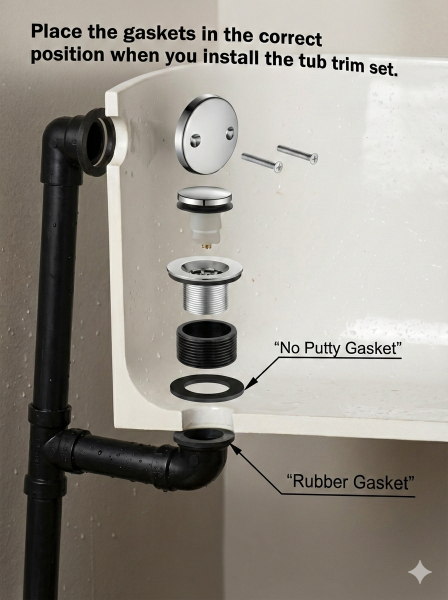
Underneath your tub, sandwiched between the tub floor and the drain pipe, is a thick rubber gasket.
- The Risk: When you unscrew the drain, that gasket can slip or fall off the shoe. If it falls into the ceiling below, you have a big problem.
- The Fix: Don’t stress too much—it usually stays stuck to the pipe shoe due to age. Just work slow and steady. Don’t jerk the drain out. If you move gently, the shoe and gasket will stay right where they are, waiting for the new drain. The new gasket is bendable and can be worked in below the pipe it is slow and can be difficult to do but achievable.
Re-Installation: Silicone vs. Plumber’s Putty
This is the biggest debate in plumbing.
- Old School: Most guys use Plumber’s Putty. It works fine, but it has a slight yellow/grey tint. Over time, it dries out and cracks.
- My Preference (Silicone): I use 100% Clear or White Silicone.
- Why? It looks better. Putty looks “dirty” against a bright white tub.
- The Seal: I can be extra generous with silicone. I put a heavy bead around the underside of the new drain flange.
- The Finish: When I screw it down, the silicone squeezes out. I wipe it clean with a rag (and maybe a little denatured alcohol), and it leaves a perfect, invisible, waterproof seal that lasts forever. If you use putty, you often end up having to silicone over it anyway to make it look nice—skip the double work.
Summary Checklist
- [ ] Try the Shop-Vac method first if it’s just a clog.
- [ ] Remember: Lefty-Loosy.
- [ ] Use the “Double Wrench” trick for leverage.
- [ ] Watch out for the rubber gasket (don’t knock it loose!).
- [ ] Use Silicone instead of Putty for a cleaner, longer-lasting seal.
- [ ] Refill your P-Trap with water when you’re done!