
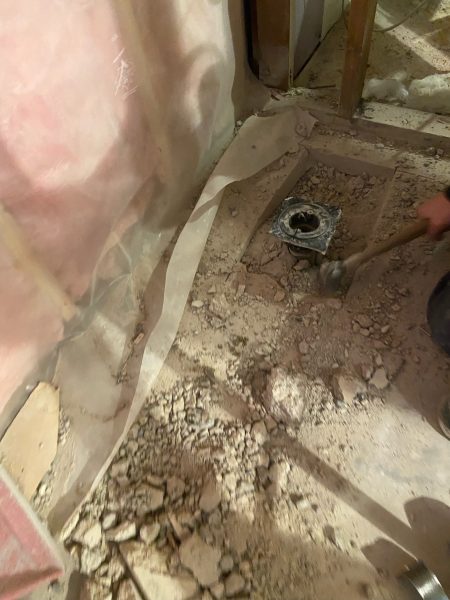
Difficulty: Level 4 (Heavy Demo) Time: 2–3 Days
Most people look at a basement bathroom and think, “I guess the tub has to stay there.” As a Journeyman, I see concrete as just another material to be moved. Yes, relocating a tub drain is a massive job, but it changes the entire flow of your bathroom.
You need to be prepared for dust. I don’t mean a little dust; I mean “cover your smoke detectors” dust.
The Tool List (Don’t Skimp Here)
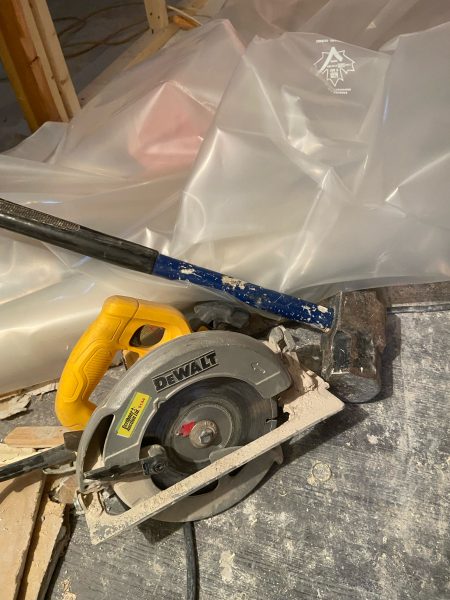
- 14″ Concrete Saw (or a Corded Circular Saw with a Diamond Masonry Blade for smaller cuts).
- 10lb Sledgehammer
- 3M Respirator/Dust Mask (Do not use a cheap paper mask; concrete dust contains silica).
- 6-mil Poly Sheeting (To build a containment tent).
- Tub Drain Kit
- PVC Cement & Primer
Step 1: The “Poly Tent” Prep
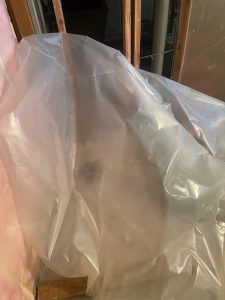
Before you even touch the saw, buy some heavy Poly Sheeting and tape off the bathroom door. Better yet, create a “tent” around your workspace inside the room.
- Why? Concrete dust is finer than flour. It will travel through your HVAC vents and coat your entire house if you don’t seal this room off.
Step 2: The Cut & The Haul
Once you know roughly where the new drain needs to go:
- Mark the Zone: Don’t try to cut a tiny hole. Mark a channel that is at least 6 inches wider than you think you need on both sides. You need room to get your hands in there to glue pipes.
- The Cut: Use your concrete saw (wet saws are best to keep dust down) or circular saw with a diamond blade to score the slab.
- The Break: Grab the Sledgehammer and start swinging. Break the concrete into manageable chunks.
- The Haul: Load the rubble into 5-gallon buckets. Don’t fill them to the top, or you’ll blow your back out carrying them up the stairs.
Step 3: The “Cardboard Template” Trick (Crucial Step)
This is where most DIYers fail. They try to measure off the wall using a tape measure, but tubs have slanted sides, no back walls, and rounded corners. It is impossible to get an accurate measurement in mid-air.
Here is the Journeyman hack to hit the hole bang-on every time:
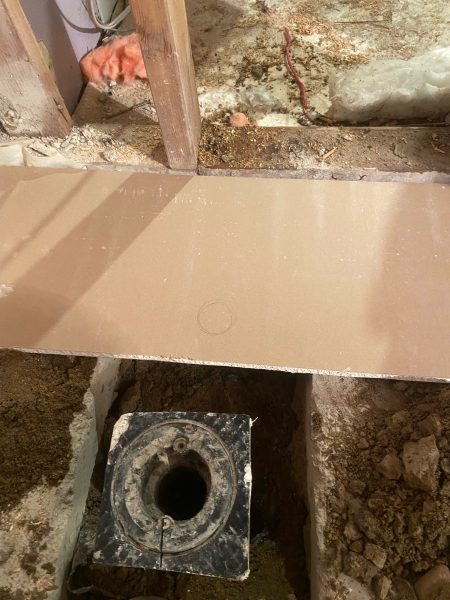
- Position the Tub: Place the tub exactly where you want it to sit on the concrete floor (or lay it nearby in the same orientation).
- The Slide: Slide a large piece of cardboard underneath the tub drain area.
- The Mark: Reach down through the drain hole of the tub and trace a circle onto the cardboard with a sharpie.
- The Transfer: Now, remove the tub but leave the cardboard. Or, if you did this nearby, push the cardboard against the framing walls exactly where the tub will go.
- The Bulls-Eye: That circle on the cardboard is your exact drilling target. No tape measure guessing games required.
Step 4: Plumbing the “Side-Run” Overflow
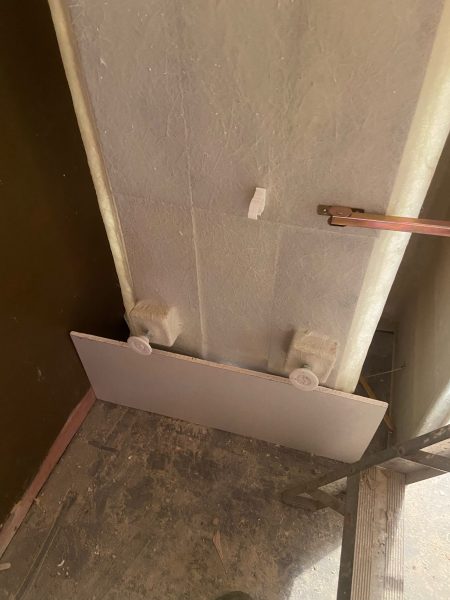
Here is the problem with standard “Tub Drain Kits”: They assume your drain and overflow are perfectly aligned in a standard setup. When you move a drain, you often end up with angles that don’t match the pre-fab kit.
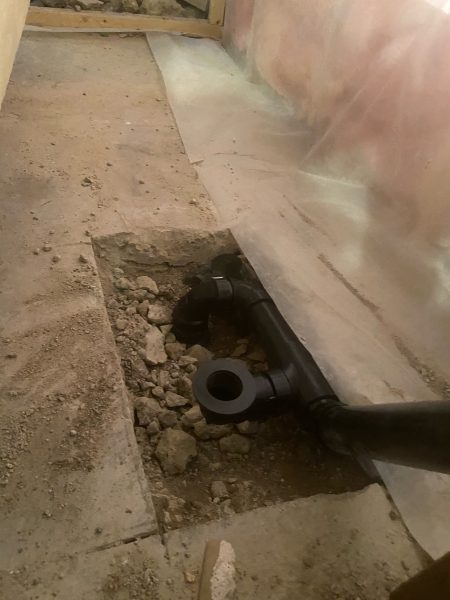
- The Issue: The rigid pipes in the kit will point the wrong way, or the overflow pipe will be on the wrong side of the drain.
- The Fix: Don’t force the kit. Instead of having the overflow drain down into the shoe (standard), I prefer to run the Main Line directly under the tub towards the overflow location.
- The Connection: I use a 3-way fitting (like a Wye or San-Tee) to connect the tub drain shoe into that main line from the side. You might need a 45-degree elbow to swing the tub shoe over to meet the main line smoothy.
Essentially, you are hard-piping the connection so it flows naturally back to the main, rather than relying on the flimsy slip-joint nuts of a cheap kit.
Step 5: Connection and Leveling
- Tie-In: Connect your new 1.5″ or 2″ PVC into the existing main line you exposed in the trench.
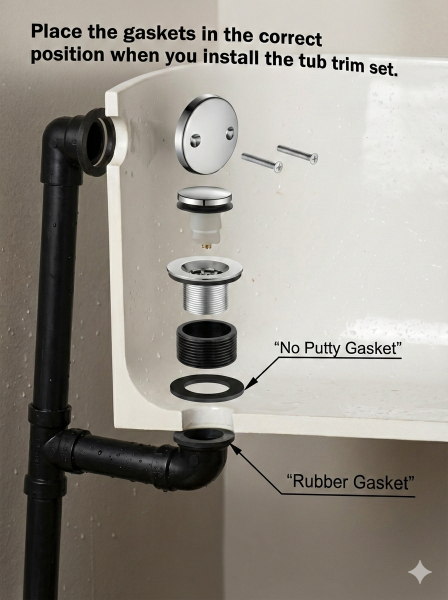
- The Gasket Check: Before you drop the tub, check your seals. The thick Rubber Gasket goes on the underside of the tub shoe (outside the water zone). Putty or Silicone goes on the top flange (inside the tub). [Not sure which sealant to use on the top flange? Read my guide on How to Remove a Tub Drain where I break down why Silicone wins every time.]
- Level & Secure: Set the tub into a bed of mortar (if specified) or shim it level. Screw the flange to the studs.
- Final Overflow Assembly: Now that the tub is locked in, use your extra PVC to connect the overflow to your rough-in. Since you built that custom “side run,” everything should line up without stress on the pipes. (you can screw in the tub drain with your own tools or the proper tool)
Why This Matters
If you try to force a standard plastic drain kit to bend 2 inches to the left, it will leak in 6 months. By cutting the concrete and hard-piping a custom angle using the “Side-Run” method, you ensure that drain flows perfectly forever.