

Difficulty Rating: Level 2 (The Apprentice)
Time to Complete: 1–2 Days (Standard Basement)
If you’ve built with Insulated Concrete Forms (ICF), you’re already ahead of the game. The walls are plumb, perfectly flat, and energy-efficient. But when it comes to finishing, many people get intimidated by the foam.
I’m here to tell you: Drywalling ICF is actually easier than wood framing. There are just a few professional “rules of the road” you need to follow regarding screws, glue, and prep to ensure a Red Seal-quality finish.
The Spec Sheet: What You’ll Need
Don’t use standard wood-framing supplies here. ICF requires specific materials to prevent the foam from dissolving and the screws from stripping.
- Screws: Use 1 5/8″ Coarse Threaded Drywall Screws. On wood studs, we use 1 1/4″ to avoid “screw pops” when the wood shrinks. Since ICF plastic ribs don’t shrink, you can go longer for a better bite.
- Adhesive: You MUST use PL 300 Foamboard Adhesive. Standard construction glue will melt the styrofoam.
- The Cut-Out Tool: I swear by the DeWalt RotoZip. It features a tool-less bit change (no wrench needed) and runs at the perfect speed. Pro Tip: I only use Drywall-Specific Bits; multipurpose bits snap too easily on electrical boxes.
- The Gear: For a full room, a Drywall Lift and a dedicated Drywall T like in the photo are non-negotiable for speed and accuracy. A drywall gun or a special bit for your regular drill if your only doing a little drywalling.
- For the Pro: If you are drywalling regularly or got a whole basement to do I highly recommend getting a cordless Drywall gun and a Rotozip. They speed up the work and provide a better finish i wish i had bought them sooner.
Step 1: Prep the “Concrete Boogers”
Before you grab a sheet of rock, check the top of the wall. During the pour, concrete spillage often sticks to the ICF near the ceiling.
Take a Flat Bar or a crowbar and run it along the top of the wall. These “concrete boogers” knock off easily, but if you leave them, your drywall won’t sit flush, and your taping or crown molding will be a nightmare.
Step 2: Finding Your “Studs” (The Plastic Ribs)
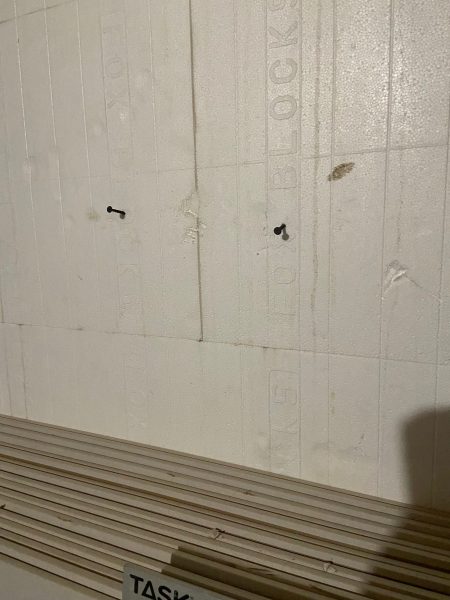
Unlike wood framing where you’re looking for a 2×4 every 16 inches, ICF uses embedded plastic fastening ribs.
As you can see in the photo, these ribs are typically spaced 8 inches apart on center. They run vertically from the floor to the ceiling. Because they are so frequent, you have a lot of flexibility, but you don’t need to hit every single one. I recommend placing your screws every 16 to 24 inches vertically along the rib. This provides plenty of holding power without turning your drywall into swiss cheese.
Step 3: The Glue & Screw Pattern
Now that you’ve located your ribs, it’s time to hang the rock. Since the plastic ribs don’t “bite” quite as aggressively as a 2×4 stud, I always recommend a “Belt and Suspenders” approach for a flat, permanent wall:
Option B (Screws Only): If you aren’t using glue, you need more mechanical bite. Sink 5-6 screws per vertical row (spaced roughly 16″ apart).Step 2: The Glue & Screw Pattern
Option A (With PL 300 Glue): Run beads of glue down the ribs. Sink 3-4 screws per vertical row (spaced roughly 24″ apart). The glue does the heavy lifting long-term, preventing any vibration or rattling.
ICF has plastic fastening ribs every 8 inches. While you can screw every 8″, I prefer a standard 16″ layout to keep it clean.
- Apply Glue: Run beads of PL 300 down the ribs.
- The Pattern: If using glue, sink 3–4 screws per vertical row (every 16″).
- No Glue? If you skip the adhesive, you need more mechanical bite. Sink 5–6 screws per vertical row.
Step 4: Order of Operations
Always follow this sequence to allow the sheets to support each other and hide gaps:
- Ceiling First: Get the lid up so the wall sheets can butt up against it for support.
- Upper Wall Sheet: Start high.
- Lower Wall Sheet: Finish at the floor. Your [Baseboard] will hide any gap at the bottom, so don’t sweat a small space at the floor.
Journeyman Secrets for ICF
The Window Return Debate
How you finish the window “box” depends on the room. If it’s an unfinished space, drywall returns are fine. But if you’re finishing a living space, always go with wood liners. Drywall in a window return is a magnet for moisture—whether it’s a window left open in the rain, condensation, or a spilled plant. Wood liners look better and won’t deteriorate or mold like drywall will when it gets damp.
The “Why” Behind the Rock
Code requires ICF to be covered because the foam will deteriorate over time if exposed. You can use special fire-rated paint, but the cost is almost identical to drywall. Go with the drywall—it looks professional, protects the foam, and brings you one step closer to a finished, livable space.
💡 Summary Checklist
- [ ] Knock off concrete spillage with a flat bar.
- [ ] Use 1 5/8″ coarse screws.
- [ ] Use PL 300 (Don’t melt your walls!).
- [ ] Ceiling -> Top Wall -> Bottom Wall.
- [ ] Use a RotoZip with drywall-specific bits for boxes.