
I’ve walked into a lot of renovation sites over the years with Compass Carpentry, and I can usually tell within five seconds if a homeowner did the drywall themselves. It’s not just the dust; it’s the “landscape.” When you see a wall that looks like a topographic map of the Rockies once the light hits it, you know someone skipped the fundamentals.
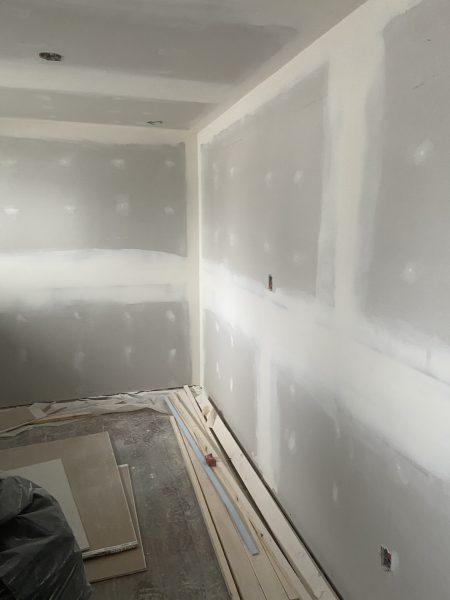
One of the worst “fix-it” calls I ever got involved a living room where the DIYer had used nearly four inches of mud to try and hide a butt joint that wasn’t feathered out. By the time I got there, the tape was bubbling and peeling off the wall like a bad sunburn. The homeowner thought they were saving money, but I had to charge them triple to scrape, cut, and redo the entire room because the foundation was a disaster.
If you want a professional finish, you have to stop treating mudding like frosting a cake and start treating it like structural layers.
The Snippet Killer: How do you get a professional drywall finish?
To achieve a professional drywall finish, you must use a “progressive layering” technique: apply a thin bed of mud, wet your paper tape before embedding it to prevent moisture-wicking bubbles, and feather each subsequent coat 2–4 inches wider than the last. Always use a side-lighting technique with a flashlight to identify imperfections before the final sanding and paint phase.
1. The “Bubble” Nightmare: Why Your Tape is Failing
The most common disaster in taping is the dreaded air bubble. If you have air under your tape, you don’t have a bond. Eventually, that bubble will turn into a crack that no amount of paint can hide.
The Journeyman’s Rule for Bubbles:
- Small bubbles (<1 inch): If it’s smaller than your fingernail, treat it like a nail pop. Press it down with the butt of your knife or a hammer, then fill it.
- Large bubbles (>1 inch): Don’t try to save it. Cut it out with a utility knife and redo the section. It sucks, but it’s the only way to ensure the wall doesn’t fail in six months.
Pro Tip: If you’re an amateur, wet your paper tape. Run it through a bucket of water before putting it on the wall. This stops the dry paper from sucking the moisture out of the mud too fast, giving you a much stronger bond and a smoother finish.
The Journeyman’s Kit: Taping Essentials
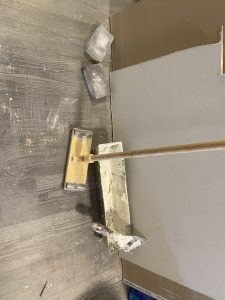
- The Blade: A 6-inch, 10-inch, and 12-inch taping knife set (Stainless steel stays smoother longer).
- The Secret Weapon: A RotoZip or spiral saw for electrical outlets. Trying to “hand cut” around boxes is a recipe for giant gaps.
- The Sanding Stick: Don’t just hand-sand. Use a pole sander to keep the pressure even across the joints.
- Foam Sanding Block: when your first starting out, this is so much easier to feel the wall and smoothness. There’s a reason it’s every amateur’s favourite even the pros break it out for those tricky sanding spots.
2. Mesh vs. Paper: Choosing Your Battles
There’s a lot of debate on mesh tape (fiberglass) vs. paper tape. Mesh is “easier” because it’s sticky, but paper is stronger.
The Hybrid Strategy
For anyone who isn’t a full-time taper, I recommend the hybrid approach:
- Horizontals (Tapered Edges): Use Mesh Tape. The boards have a natural indent here, making it easy to fill and hide the mesh without creating a “bump.”
- Verticals (Butt Joints) & Corners: Use Paper Tape. Butt joints have no indent, so you have to be an expert at feathering. Paper is thinner and easier to hide on these difficult transitions.
| Tape Type | Best For… | Pro Cons |
| Paper Tape | Verticals, Corners, Butt Joints | Harder to learn; prone to bubbling if dry. |
| Mesh Tape | Horizontals (Tapered Edges) | Thick profile; can crack if the house settles. |
3. The “Side-Light” Trick: Seeing the Invisible
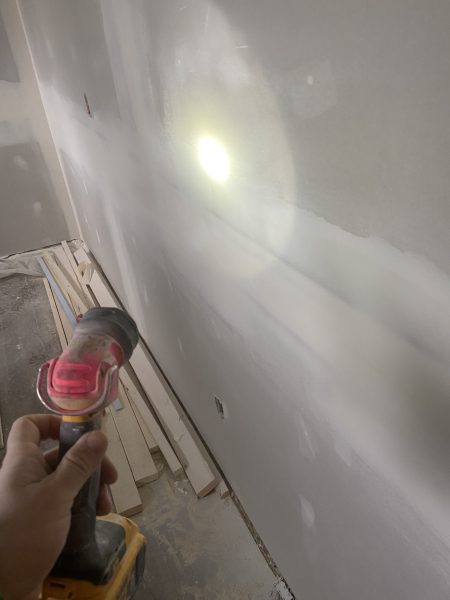
Before you even think about opening a can of paint, you need to do a “Journeyman’s Inspection.”
I never trust my eyes looking at a wall straight on. I take a high-intensity flashlight and shine it sideways across the wall. This “raking light” creates shadows behind every tiny bump, ridge, or tool mark. You might think the wall is flat, but under a side-light, it looks like a moon crater. Seriously, the trick still surprises me, how well it works.
If you see a bump, sand it or fill it now. Once that eggshell or high-gloss paint hits the wall, those bumps will be permanent features of your home.
4. Why “DIY Hanging” Usually Costs You Triple
Homeowners often think, “I’ll hang the drywall myself and just hire a pro to mud it.” Here is why that usually backfires:
- Too Many Joints: Pros “float” boards over doors and windows and cut them out with a RotoZip. Amateurs piece it together with small scraps, creating five times as many joints to tape.
- The Screw Length Trap: Most people use screws that are too long. As the lumber in your house dries (and modern lumber is rarely kiln-dried as well as it used to be), those long screws will move and create “nail pops.” Use the shortest screw allowed by code for your board thickness. Which in most places is the same thickness as the material you’re going through, so for half inch drywall you’ll need an 1 inch long screw.
- Deep Screws: If you break the paper face of the drywall with the screw head, the screw has zero holding power.
5. The Final Phase: Dust and Paint
The biggest mistake happens after the sanding is done. You’ve spent hours making it smooth—don’t ruin it now.
Vacuum the Walls
Before a drop of primer touches the wall, you must sweep or vacuum the walls. If there is any leftover gypsum dust, your paint won’t actually bond to the wall; it will bond to the dust. This leads to peeling paint later.
The “Between-Layer” Sand
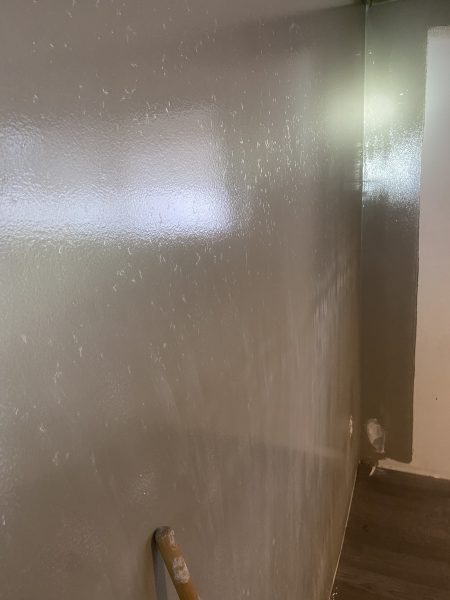
For a professional look, run a sand stick over the entire wall between every single coat of mud. It knocks down the “burrs” and keeps the finish from looking amateur and “chunky.”
The Paint Choice
If you aren’t a pro, stay away from high-gloss paint. Gloss reflects every single imperfection. Stick to a standard Eggshell finish. It’s durable enough for a hallway but forgiving enough to hide the fact that you aren’t a Red Seal taper.
What’s Next?
Mastering the mud is about patience and the right tools. If you’re ready to tackle the next step of your renovation, check out my other guides: