
Difficulty: Level 3 (Patience is key)
Time: 2 Days (Account for shrinkage)
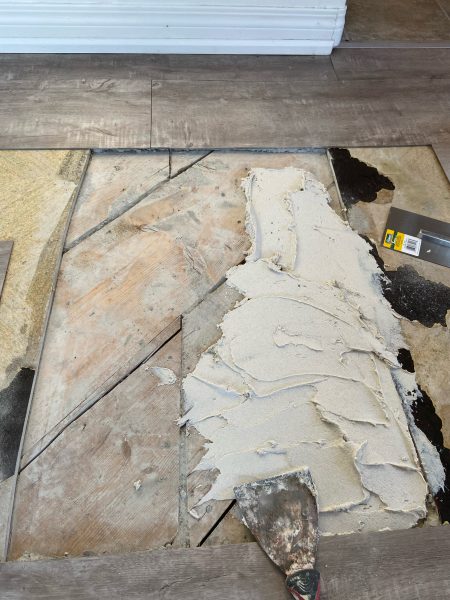
I recently walked into a job where the homeowner had a “situation” similar to what you’d see in a nightmare renovation photo. There was a massive dip in the main level floor. In a perfect world, you’d just cut out the subfloor board and replace it. But life isn’t perfect, and sometimes the plumbing, wiring, or structural layout means you can’t just “swap a board.”
If I had used the standard concrete powder mix for this, it would have been a disaster. That stuff is much more watery than you’d suspect. It would have run right through the cracks in the subfloor, and I would have spent the entire day in the crawlspace cleaning up a mess instead of leveling a floor.
Instead, I went with premixed concrete floor leveler. It’s thicker, it stays where you put it, and it doesn’t try to escape through every pinhole in your house.
Direct Answer: What is the Best Way to Patch a Floor?
For localized floor patches and deep divots, use a premixed self-leveling compound rather than a powder mix. Premixed leveler has a thicker, mud-like consistency that won’t run through subfloor cracks and allows for better manual manipulation with a flat trowel. For pours deeper than 1/4 inch, expect the material to shrink slightly, requiring a second “skim” coat the following day for a perfectly flat finish.
The Journeyman Toolkit: The Leveling Essentials
Don’t start the pour until you have your dams built. Once the mud starts flowing, you don’t have time to look for tape.
🛠️ The Prep Station
- Dewalt High-Suction Shop Vac (If there is dust, the leveler won’t stick. Period).
- Tuck Tape / “No Leak” Underwater Tape (My secret weapon for sealing holes before the pour).
- Weatherstripping Foam (The best way to build a “dam” around your patch area).
1. The “Premix” Advantage: Control Over Chaos

Most people reach for the powder because it’s cheaper. But when you’re patching a specific area, ready-mixed floor leveling compound is the smarter move.
- The Consistency: It moves more like drywall mud than water. This allows you to spread and manipulate it into the low spots without it “self-leveling” right out the door and into the hallway.
- The Prep: Because it’s thicker, you don’t have to spend five hours “waterproofing” your subfloor.
- The Stick: I always match my primer to my patch. If I’m using DAP or Henry premix, I buy their brand-specific primer. It ensures the bond is chemical, not just mechanical.
2. Step-by-Step: The “Two-Side Bridge” Technique
When I tackled that vinyl drop floor, the first thing I did was tear up the flooring to see the damage. Luckily, if its a vinyl drop—easy to pull up and glue back down later.
The Cleanup
You have to clean the area extra well. I’m talking “surgical suite” clean. I use a vacuum with a brush attachment to get every bit of grit out of the cracks. If you leave dust, your patch will eventually delaminate and “click” every time someone walks on it.
Building the Dam
I use weatherstripping and Tuck Tape to seal off the area. If you’re worried about leaks, keep a roll of “underwater” or “no-leak” tape handy. If you see a bead of leveler starting to escape, slap that tape over the hole immediately. It’s the only stuff that sticks to wet concrete. With the premixed stuff i have filled holes half an inch thick without tape or backing.
The Pour & Spread
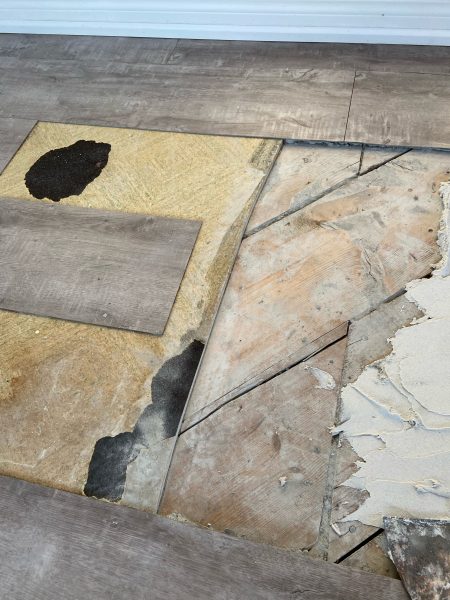
Don’t just dump it in the middle and hope.
- Start on Side A: Get it level with the existing floor.
- Move to Side B: Get that side level.
- Bridge the Middle: Work the two sides together with a flat trowel.
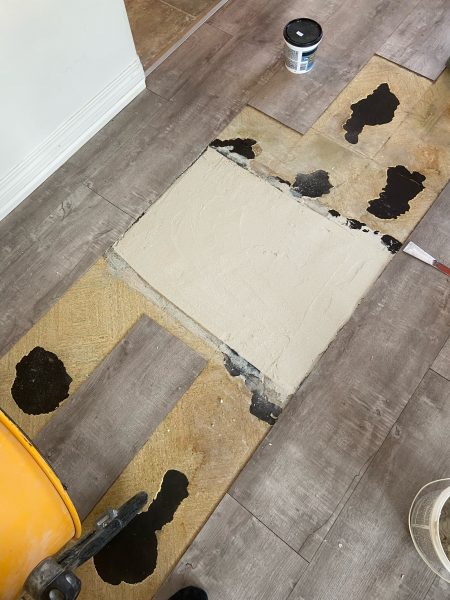
- The “Screed” Move: You can either scrape all the way across for a wide area or work in sections. Use the trowel to “feather” the edges until you can’t feel the transition with your hand.
The Journeyman Toolkit: Spreading the Wealth
You don’t need a spiked roller for small patches, but you do need a stiff edge.
🛠️ The Finisher’s Gear
- Stainless Steel Flat Trowel (A stiff edge is better for “premix” than a flexible one).
- 4-Foot Level (Your eyes will lie to you; the bubble won’t).
- Premixed Floor Patch (DAP/Henry)
3. The “Shrinkage” Trap: Why You Need Two Days
Here is the unpopular truth: Concrete floor leveler shrinks. If you’re filling a tiny nick (1/8th of an inch), you’re fine. But if you’re filling a 1/4 inch divot or deeper, the water will evaporate out and the patch will “bowl” in the center.
The Journeyman Rule: Don’t try to get it perfect in one pour if it’s deep. Apply your main patch, let it dry overnight, and come back the next day. You’ll see a slight dip. Apply a thin “skim” coat straight on top to bridge the gap from one side to the other. Bada-bing, bada-boom—done.
4. Comparison: Powder vs. Premixed Patch
| Feature | Powder Self-Leveler | Premixed Patch Compound |
| Consistency | Watery / Liquid | Mud-like / Thicker |
| Best For | Whole-room pours | Localized patches / Cracks |
| Leak Risk | High (Will find any hole) | Low (Stays put) |
| Manipulation | Difficult (Flows away) | Easy (Trowel-friendly) |
| Drying Time | 4–24 Hours | 2–12 Hours |
5. FAQ: Concrete Leveling in 2026
1. Can I just put a new board over the dip?
In an ideal world, yes. But if you’re dealing with a main level floor where you can’t access the joists easily or there’s a mess of utilities underneath, premixed leveler is the only way to get a flat surface for your new vinyl or tile without a full demolition.
2. Do I have to use primer?
Yes. Wood and old concrete are “thirsty.” They will suck the moisture out of your leveler before it has a chance to bond, leading to cracks. Always use the primer that matches your brand of leveler.
3. Can I walk on it right away?
Most premixed patches are “walkable” in 2–4 hours, but don’t glue your floor down yet. Give it 24 hours to ensure all the shrinkage has happened. If you glue down too early, the patch might pull away from the flooring as it dries.
What’s Next?
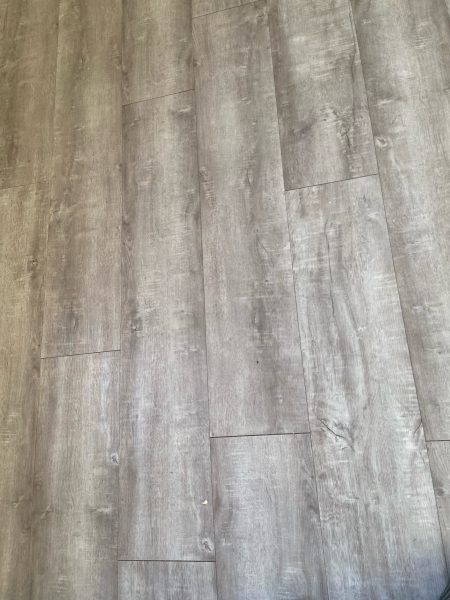
Once your floor is flat and the vinyl is back down, you might notice the walls look a bit rough by comparison.
- Need to fix a hole in the drywall? Check out my California Patch Masterclass.
- Doing the trim next? Read up on The Best White Silicone for Baseboards.
- Getting ready to paint? See Which Drywall Mud Box Should You Use
Find more “straight-talk” repair guides at Journeymantips.com.