
Difficulty: Level 2 (Framing Basics)
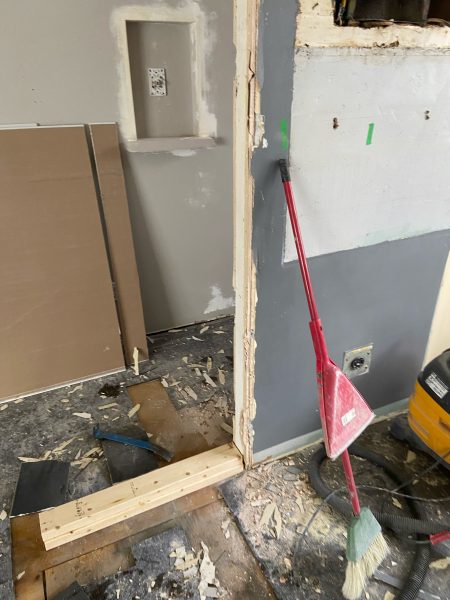
Keywords: How to extend an interior wall, framing a wall extension, flushing new drywall to old.
The hardest part about extending a kitchen wall or closing off a room isn’t the framing itself—it’s making sure the new wall is perfectly flush with the old one. If you are off by even an 1/8th of an inch, there will be a “hump” that no amount of sanding can hide.
Here is the easiest way to extend a wall using a simple straight-edge trick and a scrap piece of drywall.
The Tool List
- 6-Foot Level (Or the straightest 2×4 you can find).
- Framing Hammer or Framing Nailer.
- Ramset Powder Actuated Tool (For concrete floors).
- Safety Glasses (Essential—especially for concrete nails).
- Chalk Line
Step 1: The “Drywall Spacer” Trick
To get the new wall perfectly flush with the old one, you have to account for the thickness of the drywall before you even nail the first board.
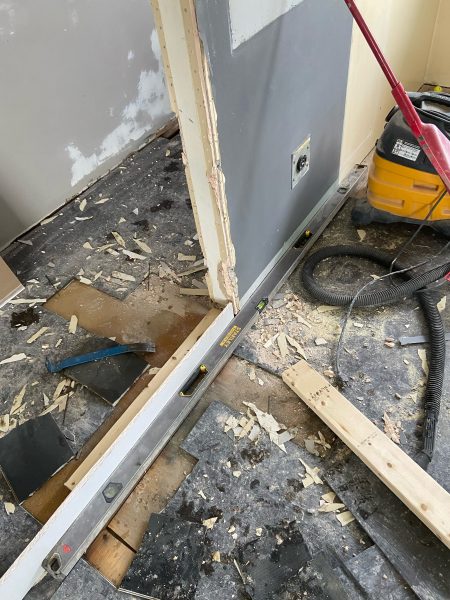
- The Spacer: Place a scrap piece of 1/2″ drywall (or whatever thickness is on your existing wall) against the old stud.
- The Straight Edge: Place your 6-foot level against that scrap piece and draw your line on the floor.
- No Scrap? If you don’t have drywall lying around, just measure exactly 1/2″ out from the existing stud and mark your line.
This ensures that once your new 2x4s are up and you add the new drywall, the surface will be 100% flush with the old finished wall. No “bump-out,” no “dip.”
Step 2: Securing the Bottom Plate
Lay your bottom plate down against your mark. Now, let’s talk about fasteners.
### ⚠️ Pro Tip: Stop Using Deck Screws for Framing This is my biggest pet peeve. Do not use deck screws to frame a wall. Screws are brittle; they have great pull-down strength but zero tensile (shear) strength. If the house settles, a screw head will snap off. Use nails. They are designed to bend, not break, under the weight of a house. You can use them with nails but never just screws.
- For Wood Floors: Use 3-inch framing nails.
- For Old Concrete: I use a Ramset. It’s fast and reliable.
- For Fresh Concrete: You can use concrete nails and a hammer.
- Safety Warning: If you are hammering into old concrete, wear safety glasses. Those nail heads can snap off and fly at you with impressive speed.
Step 3: The “L-Stud” Finish (The Anti-Warp Move)
At the end of your new wall extension (the “floating” end), I always double-stud the last board in an “L” fashion. Modern lumber is getting harder and harder to find straight. If you use a single 2×4, it’s almost guaranteed to have a crown or a warp. By nailing two boards together in an “L” shape, you create a rigid corner that stays dead-straight. This stops a warped board from creating a curve in the wall that ruins the whole look.
Why the Mudder Will Thank You
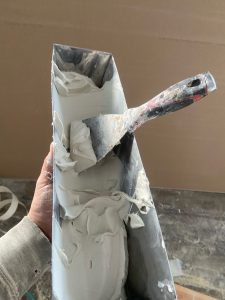
In the world of renovations, the “Mudder” (the drywall finisher) usually spends half their time trying to fix the framer’s mistakes. When you use the Drywall Spacer and the L-Stud methods, you are handing them a perfect canvas.
- No “Feathering” for 4 Feet: When the new wall is flush, the mudder only has to tape the joint. If it’s not flush, they have to “feather” the mud out for three or four feet to try and trick the eye into thinking the wall is straight.
- No Ghost Curves: Because of that L-Stud, your wall won’t have a “belly” or a curve in it. A curved wall is a mudder’s nightmare because the corner bead will never sit right.
- Fewer Cracks: Using nails instead of screws means the wall can settle slightly without the fasteners snapping, which means fewer “nail pops” and cracks in the finished mud later on.
If you make the mudder’s job easy, the finished wall will look like it was always part of the house. If you do find Warped wood and you dont want to pull it out and reinstall it check out this article: How to Fix Warped Wood In Place (Without Tearing It Out)