
Difficulty: Level 3 (Steady Hand Required)
Time: 30 Minutes
Keywords: Fix warped mantel, electric fireplace bump out, leveling a mantel in place.
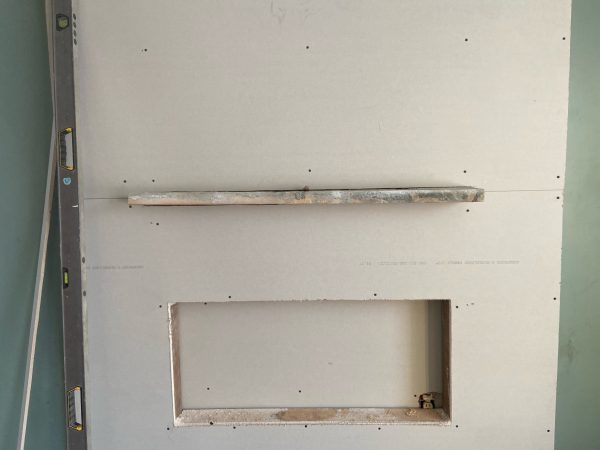
We’ve all been there. You are building a DIY electric fireplace bump-out, and you need a substrate for the mantel. You grab a 2×6 from the scrap pile because you don’t want to waste an hour driving to the store for one board. You frame it in, screw it tight, and step back to admire your work.
Then you see it. The board is warped. It slopes hard to one side. But it’s already glued and screwed to the studs, and the drywall might even be up. You can’t rip it out without destroying the wall.
Don’t panic. You don’t need to demo the wall. You just need a circular saw, a level, and a little bit of geometry. Here is the “Cut & Flip” trick I used to save my fireplace project.
The Setup: Using What You Have
I’m a Journeyman Carpenter, which means I hate wasting time and material. For this project, I used a rough 2×6 that had been used as a concrete form. Was it pretty? No. Was it straight? Definitely not. But it was strong, free, and sitting right there.
Since I planned to cap this mantel with MDF and baseboard trim anyway, the wood underneath didn’t need to be pretty—it just needed to be a solid, square anchor.
The Fix: The “Cut & Flip” Technique
The problem was that the board tapered—it was high on the right side and low on the left. If I just clad it like that, my finished mantel would look like a slide.
Here is how I squared it up without removing it:
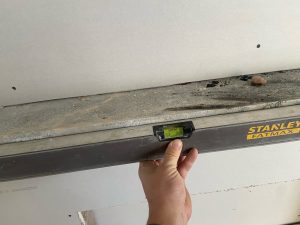
Step 1: Find the Low Spot
Grab your level (a 2-foot or 4-foot level is best). Place it on the low side of the mantel (the height you want to keep). Hold it perfectly level across the board to the high side.
Step 2: Mark the “Wedge”
Draw a line across the face of the board where level is. On the high side, you’ll see a triangle of wood sticking up above your line. That’s your enemy.
Step 3: The Freehand Cut
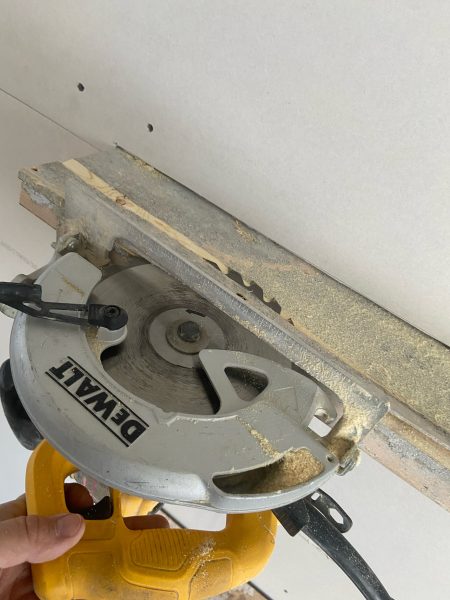
Warning: I’ve been running a saw for 20 years, so I freehanded this cut along the line. If you are a beginner, screw a straight board to the face of the mantel to act as a guide for your saw.
- Set your circular saw depth to cut all the way through the 2×6.
- Carefully cut that top wedge off. Do not throw it away.
Step 4: The “Flip”
This is the magic part. Take the wedge you just cut off the top of the high side.
- Flip it over.
- Move it to the bottom of the low side.
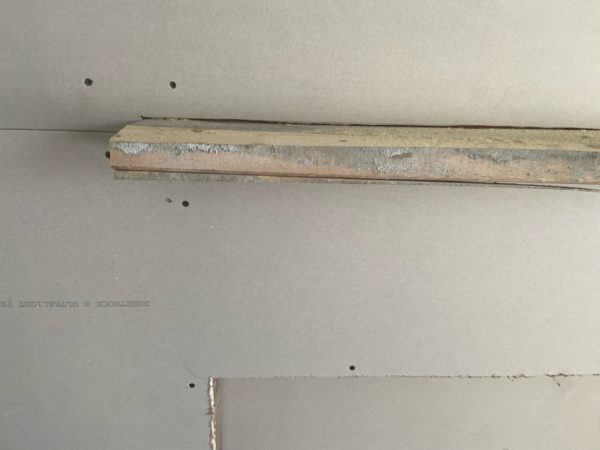
By moving that wood from the top-right to the bottom-left, you effectively turn a tapered board into a perfect rectangle. Now your mantel is level on top and square on the bottom for your trim.
Step 5: Fasten It
I used wood glue and drywall screws to attach that wedge to the bottom because that’s what I had in my pouch. (If you’re shopping, Wood Glue and Brad Nails are technically better to prevent splitting, but sometimes you just use what’s in the truck).
The Finish: Hiding the Crimes
Now that the substrate is level and square, the ugly concrete form board doesn’t matter.
- Clad the Top/Bottom: I ripped strips of MDF to cover the top and bottom faces.
- The Face: I attached a piece of nice baseboard trim to the front to give it a profile.
- Paint: Caulk the seams, paint it white, and no one will ever know that underneath that fancy mantel is a warped, twisted piece of concrete form lumber.
Summary Checklist
- [ ] Don’t demo the wall; fix the wood in place.
- [ ] Mark level from the low side.
- [ ] Cut the high wedge off.
- [ ] Glue that wedge to the bottom of the low side.
- [ ] Clad with MDF for a seamless finish.