
Difficulty: Level 3 (The Red Seal)
Cost: ~$100 (vs. $2,000+ for a pro)
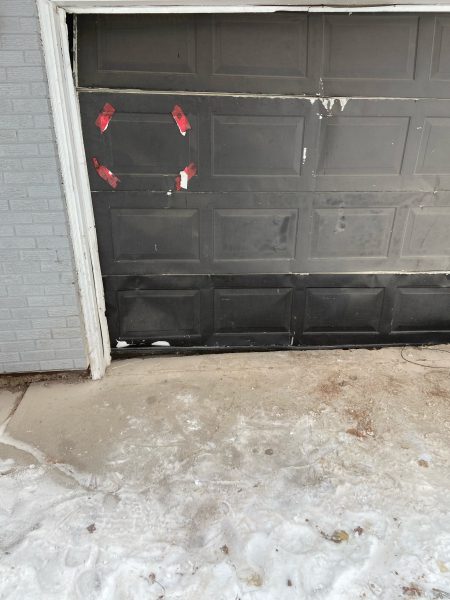
If you have an uneven garage door or a massive gap between the garage door and the floor, you know the struggle. You can adjust the door limits all you want, but if the concrete has heaved or settled, the seal won’t touch. That gap is an open invitation for mice, water, and freezing drafts.
Most people think fixing this requires a jackhammer and a professional crew. It doesn’t.
I’m going to show you how to fix a concrete garage door threshold effectively and affordably using tools you likely already have. We are going to cut out the bad section, re-pour it level, and seal that garage up tight.
The Spec Sheet: Tools & Materials
To keep this DIY-friendly, we aren’t renting a massive wet saw. A standard circular saw works fine if you take your time.
The Tools:

- 7 1/4″ Circular Saw (Your standard wood saw works, just clean it well after!)
- Diamond Masonry Blade (Crucial: Get a continuous rim or turbo blade for cleaner cuts).
- Angle Grinder (For cutting close to the walls where the circular saw can’t reach with smaller diamond blade).
- Respirator with P100 Filters (Don’t use a paper mask. Concrete dust contains silica, which is terrible for your lungs).
- Sledgehammer (The fun part).
- Magnesium Float & Steel Trowel (Mag floats bring the water up; steel trowels seal it smooth).
- 6 foot Level
- String Line ( To help you level your concrete)
- Chalk line (To help mark where to cut)
The Materials:
- Concrete Mix: Standard Quikrete or Sakrete works perfectly.
- Concrete Nails: For mechanical bonding.
- Rebar: To reinforce the new pour.
- Concrete Bonding Adhesive: To help the old and new concrete stick.
Step 1: Diagnose the “Why”
Before you cut, look at why the concrete moved. On the job where I took these photos, tree roots had lifted the driveway, pulling the garage pad up and creating a hump. If you have roots nearby, you might need to deal with them first, or the new concrete will just crack again.
Step 2: Map the Cut
You need to blend the new level threshold back into the existing floor so it isn’t a steep ramp.
- Find the High Spot: Use your level to find the highest point of the uneven concrete.
- Mark Your Lines: I measured back about 12 inches on the sides and tapered it back 2 feet on the right end where the floor had really sunk. This gradual slope makes it easier to drive over and look better.
- Snap a Line: Use a chalk line to mark your cut.
Step 3: The “Poor Man’s Wet Saw”
You don’t need a $1,000 concrete saw. Grab your circular saw and a diamond blade.
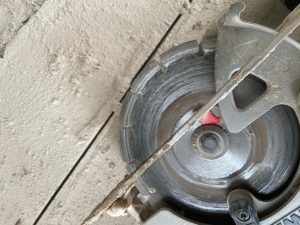
- Dust Control: This kicks up a mountain of dust. Wear your respirator.
- Cooling the Blade: If you have a helper, have them spray a little water on the blade with a garden sprayer as you cut. This keeps the dust down and the blade cool.
- The Solo Method: If you are working alone, cut for 20–30 seconds, then pull the saw out and spray the blade to cool it down. This extends the blade life significantly.(bonus cools saw down too)
- The Grinder: Use the angle grinder to finish the cuts flush against the wall where the circular saw foot plate hits. Also Use a smaller diamond blade to cut the concrete with your grinder.
Step 4: Demo & “Checkerboard” Cuts
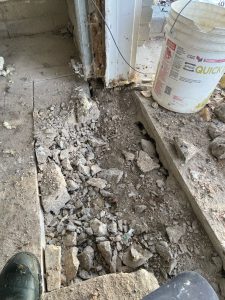
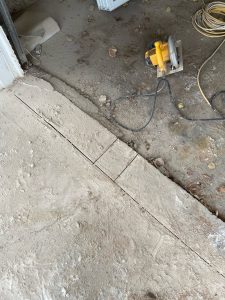
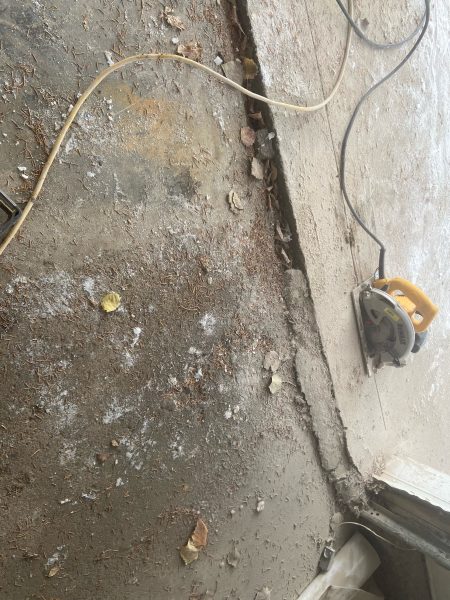
Journeyman Tip: Don’t just cut the outline. Cut a couple verical strips inside the removal zone about a foot apart like the photo below. Take your sledgehammer and smash out the sections. This takes some sweat, so crank up your jobsite radio and get into a rhythm. Because you cut the relief strips, the concrete will break out easily in chunks rather than one giant slab, ggiving you a great area for pulling the concrete out. Once you remove that section the rest goes easier. Next clean out all the rubble.
Step 5: Prep for the Bond (Crucial!)
New concrete hates sticking to old concrete. You need to mechanically lock it in.
- The Nail Trick: I like to hammer concrete nails halfway into the vertical face of the old slab. These act like mini-anchors to hold the new pour tight to the old floor.
- Rebar: Lay your rebar in the trench to give the threshold strength.
- Bonding Agent: Paint a liquid Concrete Bonding Adhesive onto the old cut edge. This acts like glue.
Step 6: The Pour & Level
- The Mix: Mix your Quikrete in a wheelbarrow or bucket. You want a “thick chili” consistency—not too runny (it will be weak) and not too dry (it won’t smooth out).
- Pour & Screed: Fill the trench. Use a straight 2×4 to “screed” (scrape) the wet concrete level with your string lines that you set to level.
- Check Your Level: While the concrete is wet, put your long level on it! You only get one shot at this. Ensure it’s flat where the door seal hits.
Step 7: The Finish
- Mag Float: Use the magnesium float first to push the rocks down and bring the “cream” to the top.
- The Thumb Test: Wait until the concrete is hard enough that you can step on it and leave only a 1/4″ imprint.
- Steel Trowel: Now, hit it with the steel trowel to make it smooth and “pretty.” Remember: The way you leave it is how it will look forever.
Pro-Tip: The “Perfect Blend”
If you finish and find the seam between the old and new concrete looks rough, don’t panic. Once it cures, you can use a Concrete Patching Compound with a bonding agent to feather the edges together for a seamless look.
Troubleshooting: What If…?
Q: I hit metal while cutting the concrete! A: If your saw suddenly sparks and stops cutting, you likely hit the old rebar or wire mesh. Don’t worry about it, it will slow down your saw and dull the blade a bit but you will make it through.
Q: How long until I can drive on it? A: Patience pays off here.
- Foot Traffic: You can walk on it after 24 hours.
- Vehicle Traffic: Do NOT drive on it for at least 7 days. Concrete takes 28 days to fully cure, but at 7 days, it has roughly 70% of its strength, which is enough for a car. If you drive on it too soon, it will crack.
Q: It looks like it’s going to rain right after I pour. A: Rain will ruin your smooth finish (it exposes the aggregate, making it look like gravel).
- The Fix: Tent it. Lay a tarp or plastic sheet over the area, but do not let the plastic touch the wet concrete. Use bricks or scrap wood to hold the plastic up a few inches so the air can flow but the water stays off.
Q: It’s getting cold tonight (below freezing). A: Fresh concrete contains water. If that water freezes before it cures, the concrete will crumble like a cookie.
- The Fix: If the temperature is dropping below 0°C (32°F) overnight, cover the new patch with insulated concrete blankets or old moving blankets covered by a tarp. Keep it warm for the first 48 hours. The chemical reaction in it will generate some heat well its setting, so blanket it, insulated tarps is what us pros use.
One Last “Pro Tip” for the Road
Check the Seal: Before the concrete fully hardens (while it’s stiff but still workable), gently close your garage door. Check from the inside to see if there is any light coming through. If there is, you can lightly tap the concrete with your float to raise it slightly, or press it down to match the rubber seal perfectly. This is your “custom fit” moment.